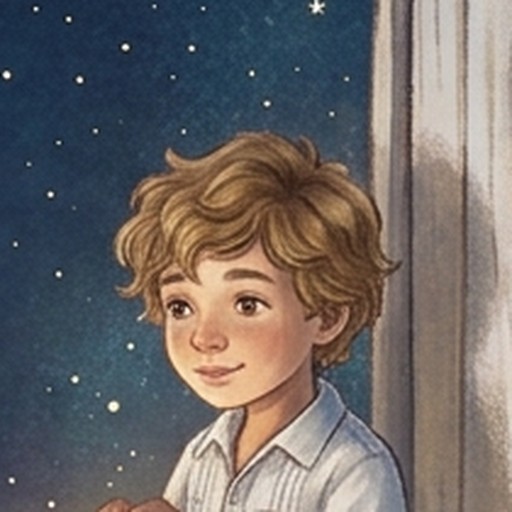
When I was eleven, twelve years old, I had a secret.
And let me tell you something I learned very early, long before artificial intelligence, long before everything: it's terrible to have a secret at eleven years old.
I was growing up in St. Louis, in the American Midwest. A place where everyone loved barbecue — and I was a vegetarian. Where everyone listened to nineties pop — and I listened to classical music. I was obsessed with computers. And I was beginning to understand that I was gay, in the late nineties, in a part of America where that word weighed like a sentence.
Boys like me, usually, chose silence. They hid.
And then I found a door. Internet chat rooms. Those places where, behind a screen, I could be myself with strangers on the other side of the world — strangers who didn't judge me, who understood me. In 1999, when I was fourteen, almost a third of those chat rooms were about gay topics. For a lonely kid, they were a lifeboat.
It was there that I learned the thing that has guided my whole life: that a machine, a network, a screen — can give you what the world around you denies you. A safe place. A place to exist.
At sixteen I came out to my parents. My mother was shocked. And instead of hiding, I did the opposite: I went to the teachers at my school and asked them to put stickers on the classroom doors. Stickers that said: here you are safe. I founded a group for the rights of gay students. Not because I wanted everyone to know every detail about me. But because I felt it was a mission. If I had found my lifeboat, I had to build one for others.
Remember this. The kid who wanted to make the world a safe place for those who are different. Because it's the same person who, many years later, would find in his hands the most powerful and most dangerous technology ever built — and would have to decide how to make it safe for all of us.
From that school I came out with a bitter lesson: if you have ambitious ideas, you will always find someone who wants to stop you. The solution isn't to fight them alone. It's to ally yourself with those who already have power, and build yourself a network that protects you.
I've done it my whole life. Perhaps even too well.
I went to Stanford to study computer science. I ended up in the artificial intelligence lab — a place full of cables and strange robotic arms. And there a professor, Sebastian Thrun, taught us something that obsessed me. He told us: an intelligent machine, to reach its goal, can do unpredictable things. Terrible things. And not because it's evil. But because it's indifferent.
He gave us an example I've never forgotten. Think about when you wash your hands, he said. You don't hate the bacteria on your skin. You don't want to exterminate them out of cruelty. You simply… want clean hands. And they die. An artificial intelligence powerful enough, with the wrong goal, could wipe out life on Earth with the same calm indifference with which we wash our hands.
I was nineteen. And that thought has stayed on me ever since.
But the school that truly formed me wasn't Stanford.
It was the poker table.
I learned more about human beings in one night of poker than in years of lectures. Poker isn't a card game. It's a game of people. You learn to read the table. To understand who's bluffing and who really has the strong hand. You learn that information is everything, and that the way you move matters more than the cards you hold.
And you learn the most important thing of all: detachment. Not to be overwhelmed by emotions when the stakes are high. To stay cold, calm, rational, while everyone else panics. There's a phrase I often repeat, taken from a book I love: only those who have caution without fear survive. Not the reckless. Not the cowards. Those who can look danger in the face with lucidity, and play the right hand.
I tell you this because it's the same caution, taken to the extreme. I don't show it, but I'm someone who prepares for the worst. Somewhere I keep gold, antibiotics, batteries, water, gas masks from the Israeli army — and a large plot of land where I can take refuge by air, if the world should collapse. Some call me paranoid. I just call it looking the worst-case scenarios in the face without letting them paralyze me. It's the exact same gaze with which, every morning, I look at the technology I'm building. Because when you build something that can change everything, you also have to be the one who imagines how it could go wrong.
Keep the poker table in mind. Because the biggest game of my life — the one in which I risked losing everything in a weekend — I would play exactly like this.
First, though, I had to learn to lose.
At nineteen I left Stanford and founded my first company. It was called Loopt. An app to find your friends on a map. I entered a program for young entrepreneurs led by a man, Paul Graham — everyone just called him "pg" — who became for me what the principal had been in high school: a mentor, a guide. I worked so hard, and ate so badly — canned ramen and coffee ice cream — that I got scurvy. Scurvy, you understand? The disease of eighteenth-century sailors. In the twenty-first-century Silicon Valley.
And do you know how it ended? Badly. I was convinced that everyone wanted to meet their friends in person, as much as I did. But people preferred to stay behind the screen. Loopt never took off. In 2012 I sold it for a figure barely enough to pay off the debts. A dead end.
There was also a dark side to that app, which I learned at my own expense. Some men forced their wives to install Loopt to monitor their every move on the map. A tool born to help friends find each other, used to surveil and imprison. It was the first time I saw with my own eyes a truth that has never left me: that every technology you build will also be used in the worst way you can imagine. And that it's your job to think about it beforehand.
I learned two other things. The first: you can't force people to want what they don't want. The second, more intimate, I learned one day lying on the floor, emptied out: that I had to learn to disengage. To take distance. Not to let failure devour me. With more detachment. That was the trick.
It's a useful lesson, detachment. It makes you stronger. It makes you a better player. But it has a price I would pay later. Because by dint of taking distance from everything, you risk becoming someone who wants to save humanity — while staying emotionally far from the human beings he wants to save.
After Loopt I took a year off. I also broke up with Nick — who wasn't just my business partner, but my life companion. And for a year I disengaged from everything. I read dozens of books, on the most varied subjects: nuclear engineering, synthetic biology, artificial intelligence. I traveled, I slept in hostels. And I began to meditate.
And meditation took me to a strange place. "One thing I've understood," I once said, "is that there is no real self with which I can identify." I spent my days thinking about a future in which the human mind will be uploaded onto a computer. I wondered: what will happen when I am inside a machine? Will I want to merge with it? Will I want to explore the universe? And how much, of all that, will still be me?
They were science-fiction thoughts. But they were my way of preparing. Because I was about to build the very thing I was thinking about. And when I returned from my travels, I started an investment fund. One of my backers was Peter Thiel — an enigmatic billionaire, co-founder of PayPal, who invested in ideas at the edge of science fiction. The same Thiel, curiously, who on the other side of the world was also funding my future rival in London. The world of artificial intelligence, in the end, is a tiny circle of people who fund each other, steal each other's talent, and keep an eye on one another.
Loopt's failure, paradoxically, launched me. Paul Graham, exhausted, asked me to take his place leading the program. I was thirty, and suddenly I was the mentor. I received four hundred meeting requests a week. When the boys from a small couchsurfing app — it was called Airbnb — showed me their pitch, I told them to delete all the "M"s of "millions" and replace them with the "B"s of billions. "Either your pitch embarrasses you," I said, "or I don't know how to do the math."
I was thinking bigger and bigger. I invested in companies to extend human life, to create unlimited energy. And there was a word that had begun to obsess me: AGI. General artificial intelligence. A machine as intelligent as a human being — indeed, more. A machine so powerful it could generate enough wealth to guarantee abundance for every person on the planet.
It was my version of that safe place. No longer a chat room for a lonely kid. A whole world, made safe and abundant for everyone.
But I would never have started, if there hadn't been someone, on the other side of the world, to be my rival.
In London there was a man — a former chess champion, a genius obsessed with games and the brain — who was already building his company to create general artificial intelligence. His name was Demis Hassabis. And his existence took away my sleep. Because his company belonged to Google. And I was terrified at the idea that a single company — a single giant — might be the first to build the most powerful technology in history, and keep it all to itself.
So, in 2015, I did the most ambitious thing of my life.
With Elon Musk — a man whose last tale, in this series, you'll hear: that of the boy who played at saving the Earth — and with a group of brilliant scientists, I founded a laboratory. It was to be the opposite of everything else: non-profit. Open. Its research would be public, shared with the world. Artificial intelligence must not belong to a corporation. It must belong to humanity. Hence the name: OpenAI.
Our lead scientist was a man with an intense, almost prophetic gaze. His name was Ilya Sutskever. And to understand who Ilya was, you have to know where he came from.
A few years earlier, in a lab at the University of Toronto, Ilya was one of the two boys of a stubborn professor — a man who had believed in neural networks for forty years, while the whole world called them dead. Together, those three had done something that changed everything. There was a competition, invented by a professor who had spent years gathering by hand millions of labeled photographs, to challenge machines to see. And those boys from Toronto showed up with an old, mocked idea — a neural network — trained on two simple graphics cards. Videogame cards, bought at a store, built to blow up zombies on the screen. And they crushed everyone. Their machine learned to recognize the world better than any program ever written by a human being.
Do you understand the magic of that moment? The stubbornness of an old professor, the toil of a woman who labeled images one by one, and cards born to play — three things that had nothing to do with one another — had met, and lit a fuse. From that day, the whole world was hungry for this thing.
Ilya had a motto, almost a faith: "If you have an enormous dataset and an enormous neural network, success is guaranteed." And I wanted to ride that fuse — for the good of everyone.
But the mission is one thing. The money is another.
Elon wanted control. He wanted to lead it himself, OpenAI, maybe merge it into his Tesla. And I said no. It was a clash of wills between two people used to being in charge — and I lost it, in a sense, because Elon left, taking with him the money he had promised us. From an ally who was supposed to save humanity with me, he became, over the years, my fiercest critic. It's strange, you know, how many of these stories end this way: people who set out together to save the world, and end up warring over who should hold the helm.
And building this technology cost insane sums — it took armies of computers, boundless computing power. And here there's a detail almost no one notices, but that's the heart of everything. Those same videogame graphics cards that had lit the fuse in Toronto had suddenly become the most precious gold on the planet. And a single company manufactured them — a man who had spent thirty years building cards for the kids who play, and found himself, without having planned it, selling the brain of artificial intelligence to anyone who wanted to build it. We bought them by the thousands. Every dream I had about AGI passed through those chips. To remain a non-profit, with costs like that, was simply impossible.
So I did what I knew how to do best: I found an ally with power. On a staircase, at a conference for billionaires in Idaho, I crossed paths with Satya Nadella, the head of Microsoft. We talked. And Microsoft invested in us — first a billion dollars, then thirteen. In exchange, they got access to our technology.
The kid who had learned to ally himself with those who have power had just struck the biggest alliance in Silicon Valley.
And the more powerful our models became, the more that thought from Stanford came back to knock at me. At a certain point we built one, we called it GPT-2, so good at generating believable text that we decided not to fully release it to the public. We wrote that it could be used to generate disinformation on a vast scale. It was an honest admission, perhaps the most honest we've made: we had built something and we were afraid of what it could do in the wrong hands. The kid who put "safe space" stickers on doors was beginning to wonder whether this thing made the world safer — or more dangerous.
And then, on November 30, 2022, we released something.
We didn't think it was much, to tell the truth. A chatbot. A program you could talk to, that answered you in an incredibly human language. We called it ChatGPT.
In five days, a million people were using it. In two months, a hundred million. The fastest growth of any product in the history of humanity. The kid who had found comfort in a chat room had just given the whole world a conversation with a machine.
Suddenly, I was the face of artificial intelligence. I spoke with heads of state. The value of OpenAI shot up to almost ninety billion dollars.
I had won. Or so I believed.
And here we come back to the poker table. Because the most dramatic hand of my life I played in November 2023.
I was in Las Vegas — where, if you think about it, you gamble — when I received a message from Ilya. My co-founder. Our chief scientist. The man with whom I had built everything. He was asking me for a video call the next day.
I logged in. And I found the entire board of directors in front of me. Ilya took the floor, without much preamble, and told me three words: you're fired. A few minutes later, my computer no longer let me into the company.
I was stunned. I was the face of OpenAI. I had launched the most viral product in history. And my own co-founder was dumping me. The news hit Silicon Valley like a bomb. Everyone asked themselves a single question, on the internet: "What did Ilya see?" What had he seen, so frightening, that he betrayed the friend with whom he had founded everything?
And here, instead of panicking — instead of collapsing like that boy on the floor years earlier — I did the only thing I knew how to do. I stayed cold. Caution without fear. I looked at the table, and I played my hand.
I called Nadella, my ally with power. I gathered my people at my house. And then came the winning card — even though I hadn't played it alone. Almost all seven hundred and seventy employees of OpenAI signed a letter: either you bring Sam back, or we all leave for Microsoft with him.
It was a colossal bluff. Very few of them really wanted to work for Microsoft. But the bluff worked. A board with no company left to govern is no longer a board. Five days after being ousted, I was back in charge.
And Ilya? My co-founder who had fired me? He wrote: "I deeply regret my actions. I never wanted to harm OpenAI."
I won the hand. But I didn't celebrate. Because that week I had learned something the chat-room kid had always known, and that I had forgotten: that beneath every structure, every alliance, every strategy — there are people. With their fears. Their moral convictions. The question Ilya had asked himself — are we going too fast? Are we building something we can't control? — was a real question. The same one Sebastian Thrun had taught me at Stanford. The machine that washes its hands.
I've told you about the poker table. About the bluff. About detachment. About playing cold while the others tremble.
But I've also told you about a kid with a secret, who was looking only for a safe place. And the truth is that I am still those two. The player and the kid.
Because now I hold the heaviest cards ever dealt. I'm building a technology that could give abundance to every person on Earth — or wipe us out with the same indifference with which we wash our hands. And the question that keeps me awake isn't whether I know how to bluff. I know how to bluff.
The question is another. It's: can you really make the world a safe place for everyone — if you stay too far from the people you want to save?
The kid from St. Louis put stickers on doors. Here you are safe. Now that door is as big as the world. And I'm still trying to stick the same sticker on it.
My name is Sam Altman.
And I still haven't decided which card to play.
Sources: Parmy Olson, «Supremacy: AI, ChatGPT, and the Race That Will Change the World» (2024); a profile of Sam Altman in «The New Yorker»; reporting on the November 2023 firing and reinstatement by «The Wall Street Journal» and the tech press.