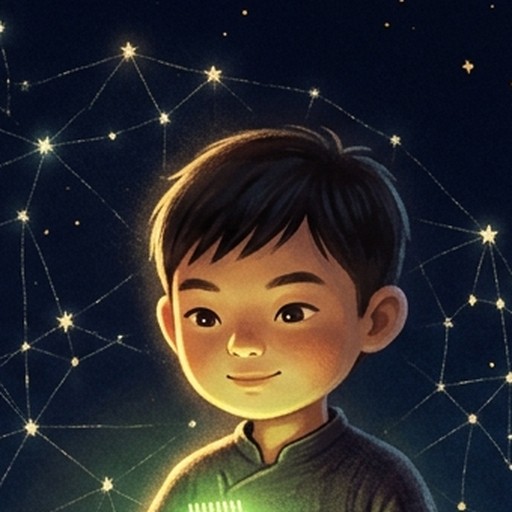
I've cleaned more toilets than any other chief executive in history.
It's not a joke. It's a fact. And today they introduce me as the man who runs the most valuable company in the world. Three trillion, three hundred billion dollars. The engine of artificial intelligence.
But before all this — long before — there was me, nine years old, in a dormitory in Kentucky, a mop in my hand, cleaning the toilets of an entire floor.
Let me tell you how I got there. Because the story that matters isn't the one about the trillions. It's the one about the mop.
I was born in Taiwan, in 1963. My family moved constantly, following my father's work. For a long stretch we lived in Thailand. And there my mother — who spoke almost no English — did something I have never forgotten.
Every day she opened the dictionary. She chose ten words. At random. And she asked us, my brother and me, to spell them and learn their meaning. Ten English words a day, from a woman who couldn't even pronounce those words.
She wasn't teaching us English. She was teaching us something bigger: that you prepare for a future you can't yet see. That you sow before you know whether it will rain.
Then Thailand entered a period of political instability. And my parents made a very hard decision: to send us to America. Alone. To an aunt and uncle, in Tacoma, in Washington State. I was only a few years old. My parents would arrive much later.
My aunt and uncle, immigrants themselves, recently arrived, did their best. They found for my brother and me what seemed to be a prestigious private boarding school in Kentucky. The Oneida Baptist Institute. They sold almost everything they had to pay the tuition.
Except it wasn't a prestigious boarding school.
It was a reform school. A place founded in 1899 to reeducate the children of families involved in feuds — boys who, without that place, would have killed one another. My parents, on the other side of the world, didn't know. They had given their savings to send their sons to what they believed was a paradise, and they had sent me to clean toilets in a three-story dormitory.
I was the youngest. I was a foreigner. I was the perfect target. In the first months they beat me several times.
My roommate was seventeen — eight years older than me — and covered from head to foot in tattoos and knife scars. Imagine a nine-year-old boy sharing a room with a boy like that.
And do you know what happened?
I taught him to read. He couldn't read, and I taught him. And in exchange, he taught me to lift weights. To get stronger. Not to be afraid.
From that place that was supposed to destroy me, I came out with something I've carried my whole life. Today I put it this way: I'm hard to scare. I'm not afraid of going to places I've never seen, and I can endure a great deal of discomfort.
Then my parents finally managed to join us, and we moved to Oregon. I went back to being an almost normal kid. I discovered ping-pong — and discovered I was good. At fourteen a magazine, Sports Illustrated, wrote that I was the most promising young player on the Northwest coast.
Then I went to Las Vegas for a national tournament. And instead of resting and focusing, I spent the night wandering the Strip, enchanted by the lights. The next day I lost all my matches.
Thirty years later, I still regret it. Because that night I learned something: talent without focus is worth nothing. The lights are always there to distract you. The work is resisting them.
And I've worked. As a boy I washed dishes. I was a busboy, then a waiter. In a chain of American diners. I hated making milkshakes — it took forever to clean everything up — and I tried to talk customers into a Coca-Cola. "Are you really sure about the milkshake?"
Remember those diners. Because in a few minutes we'll come back to them, and you won't believe it.
I graduated at sixteen — I'd skipped two grades. I studied electrical engineering at Oregon State. I was the youngest in the class, small and scrawny, and to flirt I had one line only: "Do you want to see my homework?"
It worked. That girl's name was Lori. I married her. She's still my wife.
I went to work as a microchip designer. By day I drew circuits, in the evening I studied at Stanford. It took me eight years to finish my master's, because in the meantime I had two children to raise. But I didn't care. Because I had already understood something about myself: I have a long horizon. For some things I'm impatient, but for the things that matter I have boundless patience.
And here I have to tell you the most important thing of all. When young people ask me the secret of success, I always give the same answer. An answer that throws them off.
I tell them: I wish you ample tears and blood.
Because I've learned that those with too many expectations have little resilience. And resilience is everything. Excellence isn't a matter of intelligence. It's a matter of character. And character is formed in only one way: by overcoming obstacles. The pain, the setbacks, the things that go wrong — that's the work. Not an accident along the road. It is the road.
1993. I was thirty. And with two friends — two engineers more brilliant than me — we decided to found a company.
Their names were Curtis Priem and Chris Malachowsky. Curtis could design the architecture of a chip like no one else. Chris could tame the transistors. I was the engineer who could also do everything else. The truth? Success is largely luck, and my luck was meeting those two.
And do you know where we designed Nvidia?
At a diner table. A Denny's, in San Jose. We ordered coffee, which was bottomless, and stayed there for hours and hours filling napkins with calculations.
Can you believe it? As a boy I washed dishes at a Denny's. And as a man, I founded the most valuable company in the world at a Denny's table. The same kind of table. The same cup of coffee. Life sometimes writes these things better than any screenwriter.
And here I'll confess something that clashes with the legend. At the start, I didn't want to leave at all. My two partners hated their jobs; I loved mine. I kept thinking: you two are miserable, I'm thriving — why on earth should I quit to go into business with you? I agreed on one condition only: that the company could really reach fifty million dollars in revenue. Then one day Curtis just quit, founded Nvidia on his own, in his house, and told us: "You can't let me fail alone." He worked the guilt. And it worked. Sometimes a company is born like that too: because someone jumped first, and you don't have the heart to let them fall.
We needed money. I went to my boss at LSI, Wilf Corrigan, to hand in my resignation. Instead of holding me back, he asked: "Can I invest in your venture too?" And he sent me to the most feared man in Silicon Valley: Don Valentine, of Sequoia Capital. The best venture capitalist in the world.
We gave him a demonstration. We didn't convince him at all — in fact, it went badly. But he gave us the money anyway, out of respect for my reputation. And he dismissed me with a line I've never forgotten:
"Based on what you've told me, against all common sense, I'm giving you the money. But if you lose it… I'll kill you."
The company's name? My partners started from the Latin word for "envy." Invidia. Because we wanted to build something the whole world would envy. We dropped the "I." What remained: Nvidia.
And the first thing we did was an almost complete disaster.
Our first chip was called the NV1. We put everything into it: graphics, audio, our own way of drawing images, our own sound format. We were so in love with our technology that we built a Swiss Army knife. Full of brilliant features that interested no one.
Then a videogame came out. It was called Doom. The most famous game in the world. And on our chip — our wonderful chip — Doom ran badly. The audio didn't work. Players looked at the screen and heard with their own ears that something was wrong. And there's no marketing in the world that can convince a person not to see what they see.
As Chris put it: "We thought we'd built great technology and a great product. We discovered we'd built only the first, not the second."
It was a catastrophe. We burned through fifteen million dollars. I had to lay off more than half the company: from a hundred people to forty. I looked those people in the face and told them to go home. It's something you don't forget.
But we learned. We learned that it's better to do a few things done superbly than many things done so-so. No one goes out to buy a Swiss Army knife. It's the kind of gift that shows up at Christmas and ends up in a drawer.
And here comes the moment when Nvidia should have died.
We had nine months of money left in the bank. Nine months. A competitor of ours, bigger and stronger, had already written us off — they thought we'd implode on our own, and were just waiting to pick up the pieces.
I did the only thing you can do when your back is against the wall. I told my engineers: we won't build a decent chip. We don't have the time. We'll build the fastest chip in the world. And we'll do it in nine months, when everyone else needs twenty-four.
I called it one thing: working at the speed of light. Not measuring yourself against the competition. Not measuring yourself against what you did yesterday. Measuring yourself only against what is physically possible. The ultimate limit. No excuses.
We spent a million dollars — which we barely had — on an emulator, a machine the size of a refrigerator, to test the chip without building it. It took us fifteen minutes just to load Windows. I'd move the mouse and wait for the screen to update, one frame at a time.
And then came the day I love to tell.
I gathered all the employees in the cafeteria. I pulled a sheet of paper from my pocket. I read aloud how much money we had left in the bank. I folded the sheet. And I said: "This is everything we have."
Silence. They were figures barely enough for a few weeks of salaries. A new hire went pale and said: "My God. We're out of money."
And then I pulled a second sheet from my pocket. I opened it. And I read:
"Order from STB Systems. Thirty thousand units of the RIVA 128."
The cafeteria exploded. Our first big order. We were alive.
Yes — I'd done a bit of theater. But that theater told a truth that would become the company's mantra forever: we are always thirty days from failure. Not out of fear. But so as never to fall asleep. Because the real enemy is never the competition. The real enemy is the complacency of those who've just succeeded.
That chip sold a million units in four months. The competitor that had written us off? Years later it went bankrupt. And we bought the pieces.
But surviving once is never enough. Shortly after, the American giant — Intel, a company that back then had almost a thousand times our revenue — announced it would make a graphics chip of its own. To finish us off. They said it openly to their employees: we want to see Nvidia fail.
I gathered the whole company and said something that today perhaps sounds brutal, but that back then was pure survival: "Have no illusions. Intel wants us dead. Our goal is to destroy them before they destroy us."
My engineers began working until midnight, going home wrecked, sleeping a few hours and starting again, repeating like a mantra: we have to beat Intel. I was the first. I'd get to the office at nine in the morning and leave around midnight. Once an executive left early to take his wife to the movies, and a colleague said goodbye to him like this: "Ah, only working half a day today?"
I know how it sounds. But I'd learned something in Kentucky: you don't hide. Not even in the bathroom. One of my engineers was once at the urinal, and he saw me pull up beside him and ask: "Hey, what are you working on?" He panicked, convinced I was about to fire him, and rattled off twenty projects in a row. I didn't want to scare him. I only wanted everyone to know: I see you. I know what you're capable of. And I expect you to do it.
And there was another thing I kept telling the recruiters, one rule only: always hire people smarter than you. A company is not its founder. It's the constellation of people it manages to hold together.
But the most important lesson of those years wasn't about war. It was about a friendship.
We needed someone to physically build our chips. The best in the world was a man in Taiwan — the land where I was born — named Morris Chang, the founder of TSMC. I wrote him a letter, in my own hand, asking for a meeting. Against all odds, he answered.
Chang came to visit us in person, with a small black notebook in which he took notes. Once he even came while he was on his honeymoon. He always said: "The greatest pleasure of my work is seeing customers grow, make money, succeed."
From there was born a collaboration that has lasted thirty years. I've learned that no one builds anything alone. That behind every chip that today makes machines think, there is the loyalty between two immigrants who trusted each other. This too is the constellation.
Now I have to stop and show you something. Because this is how we work.
In our meetings there are no glossy presentations. There are no shiny slides to hide behind. There is one thing only: a whiteboard. And a marker.
I spring to my feet with my favorite marker — the one with the chisel tip — and I draw the problem in front of everyone. And whoever speaks has to prove their reasoning there, in real time, in front of the others. No one can hide.
But the whiteboard is also a symbol. The most important symbol I have.
Because a whiteboard, however much you fill it with brilliant ideas, is made to be erased. Every great idea, however brilliant, sooner or later goes away, and makes room for another. The whiteboard never lets you fall in love with what you wrote yesterday. It forces you to always look at the emptiness. And the emptiness — keep this in mind — is not the end.
The emptiness is possibility. We'll come back to it, at the end.
In 2006 I made the craziest and most misunderstood bet of my life.
Our graphics cards did one thing only: draw videogames. Kids bought them to blow up zombies on the screen. But I had sensed something. Those cards, inside, did a special kind of computation — many little operations all at once, in parallel. And that computation wasn't only useful for videogames. It could be useful for science. For medicine. For things that didn't exist yet.
So I decided to turn our videogame cards into computing tools for the whole world. I created a software platform to do it. I called it CUDA. And I ordered something that enraged everyone: that every single Nvidia chip, even the cheapest one sold to kids, would have CUDA inside.
It cost a fortune. A single chip, four years of work, almost five hundred million dollars. Our margins collapsed. And demand for this new thing was… almost zero. No one knew how to program it. Our researchers gave a hundred conferences a year to explain it, and came back saying: "We're facing a wall. No one wants to hear about it."
Our stock lost eighty percent of its value. Investors begged me to backtrack. To stop.
I didn't change my mind. Not for a second.
Because I believed in CUDA. I believed deeply that that way of computing would solve problems that ordinary computers couldn't even touch. It was a necessary sacrifice. I was again sowing ten words a day from a dictionary, for a rain that hadn't yet come.
The first distant thunder came from a scientist named Andrew Ng. At Google, he had built an enormous neural network, and to train it he had linked two thousand ordinary processors — sixteen thousand computing cores. A monster. And that monster, watching thousands of YouTube videos, had learned something tender and revolutionary at once: it had learned, on its own, to recognize the face of a cat. Without anyone teaching it.
It was wonderful. But there was a problem I knew well: two thousand processors cost a fortune. No ordinary lab could afford them. That marvel was out of the world's reach.
And here a man from my team enters, Bill Dally. One morning, at breakfast with Ng, he said a sentence that changed history: "I bet our GPUs would be much better suited to doing this."
He put a brilliant engineer to work, Bryan Catanzaro. And guess what they discovered. That job that required two thousand traditional processors, our videogame cards did with twelve. Twelve. As Dally put it: "If the algorithms were the fuel, and the data the oxygen, the GPUs were the spark. Without them, it just wasn't feasible."
That was when I called Catanzaro, and began bombarding him with emails at every hour: what is this deep learning? How does it work? What do my cards have to do with it? I could smell something enormous.
And then, in 2012, the rain came. From a place I didn't expect.
There was a young professor — her name was Fei-Fei Li. If you've listened to the first tale of this series, you already know her. She had spent years building a thing everyone called useless: a gigantic archive of hand-labeled images. She called it ImageNet. And she set up a competition around it.
For two years nothing happened. Then, in the third edition, a team came from the University of Toronto. A stubborn professor named Geoffrey Hinton, and two of his students — Alex Krizhevsky and Ilya Sutskever. They brought something everyone believed dead for thirty years: a neural network. They called it AlexNet.
And to train it — listen carefully — they didn't use million-dollar supercomputers.
They used two of my graphics cards. Two videogame cards. Bought at the store. A few hundred dollars each. Those same cards I had spent twenty years building for the kids who blew up zombies.
And they crushed everyone. They made computer vision take a leap no one had ever seen.
Do you understand what had happened? It took three. Fei-Fei's data. Hinton's networks. And my cards. None of us, alone, could have done it. Fei-Fei without the computation, nothing. Hinton without the data, nothing. And my cards, without someone who dreamed of using them to think instead of to play — they would have stayed toys.
I had spent twenty years building, without knowing it, the brain of artificial intelligence. I thought I was manufacturing toys for gamers. I was manufacturing the engine of a revolution.
It's not genius. It's a constellation. It's many distant people, each chasing their own star, and at a certain point — seen from far enough away — they form a single figure.
In 2013 I gathered the board of directors and said three words: "We must go all in." I reorganized the entire company around artificial intelligence. Every best person, moved onto that. It was our absolute priority.
And those three boys from Toronto? Hinton and Fei-Fei went to Google. Ilya Sutskever founded a small startup you may have heard of. It's called OpenAI.
Ten years passed. Ten years in which we built, and built, and waited, while almost no one understood what we were doing.
Then, at the end of 2022, ChatGPT came out. And in two months it reached a hundred million people. The fastest growth of anything in history. And suddenly the whole world wanted artificial intelligence. All at once. In the same instant.
My cards became the most contested gold on the planet. Anyone who dreamed of building an artificial mind bought them — even a man who made rockets and cars, who ordered tens of thousands of them in one shot for his AI. Of him you'll hear the last tale of this series: Elon Musk.
And there was only one company in the world ready to build the engine of it. One company alone that had spent ten years, and billions, and its own reputation, preparing for a moment that didn't yet exist.
On May 24, 2023, we announced our results. We had beaten Wall Street's forecasts by four billion dollars. An analyst who'd been doing that job for fifteen years wrote a single sentence: "I've never seen anything like it." He titled his commentary: The Big Bang.
The next day the company's value rose by a hundred and eighty-four billion dollars in a single day. More than the entire value of Intel. And a little over a year later, Nvidia became the most valuable company in the world.
Now. I'd asked you to remember the whiteboard.
Do you know what I think, when people talk to me about the trillions? I think a whiteboard is only as useful as the person holding the marker. It can reflect genius. But it can't create it.
And I think of something I always repeat to my people: inside Nvidia you never look back. Not at the mistakes, not at the successes. Every morning the whiteboard is blank again. Yesterday's Big Bang is already erased. Because the moment you fall in love with what you've written — with what you've been — is the moment you begin to die.
Do you want to know what I'm writing, now, on the blank whiteboard? A boy, at a conference, asked me: "Mr. Huang, what comes after artificial intelligence?" And I answered without hesitation: digital biology.
For the first time in history, we can lay our hands on life the way we lay hands on a chip. Design proteins that don't exist in nature. Build new drugs. Read the secret language of cells. The same machines that learned to see a cat, one day will learn to heal. That's the next thing I want to wipe from yesterday's whiteboard to make room for tomorrow.
I know what I am. I'm not the smartest man. There are people smarter than me — I've hired thousands of them, on purpose. My chief financial officer beat me at chess every time, and I refused to accept it. The truth is another: no one works as hard as I do.
And there's a sentence I repeat to my people when things get hard, when someone is down: "If we fail, it must not be because someone wasn't helped. Here we work together. No one fails alone."
I often think back to that nine-year-old boy, mop in hand, in a dormitory in Kentucky, in a country whose language he didn't speak, sent there by mistake by parents who had sold everything dreaming of something better for him.
If you had told him — that boy — that one day he would build the brain of thinking machines, he would have looked at you without understanding. He had to finish cleaning the floor.
But it's precisely because of that floor to be cleaned, those punches taken, that tattooed roommate I taught to read, those milkshakes I hated, those fifteen million burned, that eighty percent lost on the stock market — it's because of all that that I'm still here.
Because the artificial intelligence you're watching being born isn't made of silicon. It's made of people. Of a mother who chooses ten random words from the dictionary. Of a girl who labels millions of images. Of a stubborn professor who doesn't give up on his networks for thirty years. Of those who kept believing in a blank whiteboard when everyone told them to erase it.
It wasn't supposed to be this hard. But it was. And it always will be.
So, to the kids listening to me in the schools, I say the only true thing I know.
The secret isn't intelligence. It isn't luck. It's character. It's pure, simple will.
And if I wish you well — if you truly matter to me —
I wish you ample tears and blood.
Source: Tae Kim, «The Nvidia Way».