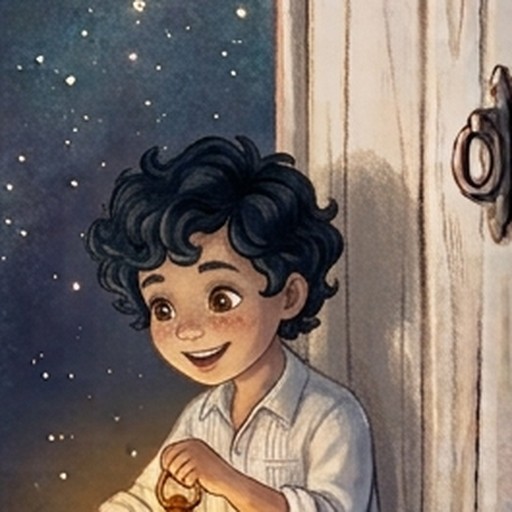
I was four years old the first time I beat my father at chess.
And shortly after, my uncle. I was so small I had to perch on a phone book to be able to see the whole board from above. At six I was winning local championships, sitting on a cushion, my legs not reaching the floor.
The other children looked at me like a circus freak. But I, on those sixty-four black and white squares, wasn't only playing. I was learning the way of thinking that would guide my whole life.
Because chess teaches you something profound. It teaches you to think from the end. You visualize where you want to arrive — checkmate, victory — and then you work backward, move after move, until you reach the one you have to make now, in this instant.
Keep this in mind. The chessboard. Imagining the end, and walking backward toward it. Because that's how I built everything. That's how, many years later, I would set a goal that seemed insane — solving intelligence itself — and would work backward, move after move, to figure out how to get there.
I was growing up in North London, and I was obsessed with games. Not only chess. All games. But above all videogames.
There was a company I adored, Bullfrog, the one that made the "God games." I wanted to work there at any cost. I entered a competition that offered a job as a prize — and I lost it. So I did the only sensible thing: I picked up the phone, called the company directly, and asked for a week's trial. They were so impressed that they offered me a summer job. I was fifteen. And when, the next year, Cambridge told me I was too young to start university, I spent the whole year in there, designing worlds, paid in cash, sleeping in a hostel. At sixteen I was designing videogames alongside the masters I had idolized.
At seventeen I created one all my own. It was called Theme Park. You built and managed an amusement park: roller coasters, stalls shaped like giant hamburgers, thousands of virtual visitors who moved, spent, had fun or got angry. It sold millions of copies. Millions. I was a teenager, and I held a small celebrity in my hands.
But the thing that really fascinated me were what we called the "God games." Games in which you don't control a single character like Mario. No: you shape entire worlds. You build a city and then strike it with an earthquake. You model the lives of thousands of virtual people from above. You become, in a sense, the mind behind a whole universe.
I didn't realize it yet, but I was already doing the thing I would do forever: building miniature worlds to understand how the real world works. Using simulation to grasp reality. The game wasn't an escape from reality. It was my microscope for looking at it.
But the moment that truly changed my life wasn't a victory. It was a defeat.
I was eleven. I was at a chess tournament in Liechtenstein, against the Danish national champion. An endless game — ten hours. Ten hours, at my age, with my mind by then on fire. I was exhausted, terrified of making a mistake, and in the end I resigned.
The Dane looked at me astonished. "Why did you resign?" he asked me. And he showed me the move I could have made — the move that would have saved me — and that I, worn out, had not seen.
I sat staring at the board. And in that moment, looking around me — all those extraordinary brains, bent over their boards, neurons burning at full power for whole days — I thought something that would never leave me: what a waste.
What a waste of intelligence. All that mental power, that genius, poured into a game. And what if — I asked myself — we could take all that intelligence and aim it at the real questions? The mysteries of the universe. The origins of life. The diseases that kill us.
Sometimes it's failure that unleashes the greatest ambition. That day I lost a game. And I won a vocation.
At sixteen, having finished school two years early, I read a book by a Nobel laureate in physics, Steven Weinberg. It spoke of the mad and magnificent search for a "theory of everything" — a single set of equations capable of explaining all the forces of the universe. Like Einstein's E equals m c squared, but for everything.
And I thought of my old computer, a Commodore Amiga, which at night, while I slept, ground through calculations. And an idea came to me that had the flavor of a prayer: what if a computer intelligent enough could help us answer the impossible questions? To understand the universe? To find, perhaps, even a divine origin?
That was when everything aligned. If I built a machine as intelligent as a human being — indeed, more — I would build the ultimate scientific instrument. An instrument for making discoveries that no human brain, alone, could ever make. My phrase, the one I would repeat my whole life, is simple: "Solve intelligence, and you'll solve everything else."
Everything. Cancer. Climate. The secrets of matter. Solve intelligence — and you have the key to every other lock.
But before I understood how to build it, I had to fail. Hard.
After university I founded my own videogame studio, it was called Elixir. And our big project was a hugely ambitious game, Republic: The Revolution — an entire simulated country, with millions of virtual citizens. We put monstrous technology into it. And what came out was a disaster. A boring game — which for a game designer is the worst possible insult. We had spent four years on the engineering, and had forgotten the soul. The reviews were lukewarm. The sales modest. Elixir collapsed. And I became yet another entrepreneur ruined by his own too-big dreams.
But from that failure was born the most important insight of my life. I had made a mistake of direction. I had tried to use artificial intelligence to build a great game. And I had to flip everything around. I mustn't use AI to make a game. I had to use games to make AI.
Games were the perfect training ground: clean worlds, with clear rules, where a machine could play millions of games against itself and learn. Games weren't the end. They were the gym of intelligence. The day I understood this, I held in my hands the key to everything that would come after.
But to build an intelligence, I first had to understand the only one that already existed. The human brain.
I became obsessed with the brain. I did everything to protect mine — I didn't drink alcohol, I trained it with games. For years, my profile picture on the internet was the scan, the MRI, of my own brain. I marveled at its complexity. Because that kilogram and a half of matter inside the skull was the only proof, in the whole universe, that general intelligence was possible. If it existed there, it could exist elsewhere. You only had to understand it, and recreate it.
I did a PhD in neuroscience. And I was inspired by a man I considered a giant: Alan Turing, the British mathematician who had imagined, decades before computers existed, an abstract machine capable of computing anything. "The human brain," I once said, "is a Turing machine." Its frightening complexity could be reduced to numbers, to data, to a mechanism. And what is a mechanism can be rebuilt.
And during that PhD I made a discovery that left me breathless. I was studying the hippocampus, the part of the brain tied to memory. And I discovered that the same region we use to remember the past also lights up when we imagine the future. Do you understand what that means? That when you remember something, in part you are imagining it. Our brains don't rewind the past like a tape: they reconstruct it, every time, the way you paint a picture. Memory and imagination are the same magic. That was when I truly understood how extraordinary — and how rebuildable — the machine inside our skull is.
I wasn't alone, in that race. I found two companions. Shane Legg, a researcher who had written his thesis on "machine superintelligence" and who had arrived, on his own, at the same conclusion as me: that this would be one of the most important undertakings in history. And Mustafa Suleyman — a childhood friend, raised in my own neighborhood, with whom as boys I had even gone to Las Vegas to play poker, coaching each other and splitting the winnings. Three different minds, one single obsession.
In 2010, the three of us founded a company to do the craziest thing imaginable: build a general artificial intelligence. We called it DeepMind. Our internal motto was exactly my old phrase: solve intelligence, then use it to solve everything else.
We were so out of step that practically no other company in the world was attempting the same feat. Every professor I spoke to about it told me: "Don't even think about it." I was risking my scientific reputation.
And then, in 2012, came the proof that all of us stubborn ones were waiting for. In an image-recognition competition — organized by a scholar who had gathered by hand millions of photographs — an old professor who had believed in neural networks for a lifetime showed up, with two of his students, and crushed everyone. They had used the same "dead" idea I was betting the company on: neural networks, artificial brains, trained on mountains of data and on videogame graphics cards. Suddenly, the thing the professors told me not even to attempt became the thing everyone wanted to do. The wind had changed. And I had raised my sails years in advance.
I found someone who believed in me — an investor who, as it happened, loved chess. I won him over by talking to him about the perfect balance between the knight and the bishop.
And to convince the giants that we were serious, we showed them something simple and magical. A machine of ours that learned on its own to play an old Atari videogame — Breakout, the one where a ball smashes through a wall of bricks. No one taught it the rules. We rewarded it with a point when it did well, and it, by trial and error, in a couple of hours learned to play better than any human being — even discovering tricks we didn't know. When we showed it to Larry Page, the head of Google, he was thunderstruck.
The offers began to pour in. Mark Zuckerberg offered me eight hundred million dollars to buy us. I refused. Elon Musk — whose last tale in this series you'll hear, and who a few years earlier had invested in my company to keep an eye on it — wanted to pay us in shares of his Tesla. I refused him too. In 2014 I accepted Google — six hundred and fifty million dollars — but only because I set two conditions I would not negotiate.
The first: Google would never use our technology for military purposes. Never weapons. The second: there had to be an ethics committee, with real legal power, to oversee any powerful intelligence we built. Because I knew, from the very start, that I was handling perhaps the most powerful technology of all time. And whoever handles a thing like that must have someone to keep their hand steady.
Google agreed. And then, a few years later, it dismantled that committee. It was one of the first times I understood a painful truth: that when a technology becomes valuable enough, ethical promises are the first thing to be erased.
But I wasn't racing alone. On the other side of the ocean, in San Francisco, a rival had been born — a young, brilliant entrepreneur who had recruited some of my own collaborators. His name was Sam Altman. His existence made me boil with anger and kept me awake at night. But it also pushed me to run faster. Every great player needs an opponent worthy of them.
And then, in March 2016, I did something that closes a circle begun when I was four years old on the phone book.
We built a machine — we called it AlphaGo — and took it to Seoul, in Korea, to challenge Lee Sedol, one of the greatest champions ever of the game of Go. Go is thousands of years old, and it's far deeper than chess: there are more possible configurations on a Go board than atoms in the known universe. No one thought a machine could beat us at that game. Not for decades.
Two hundred million people were watching.
In the second game, our machine made a move. Number thirty-seven. A move so strange, so alien, that all the commentators thought it was a mistake. A bug. No human master would ever have played it. Lee Sedol got up from the table, left the room. He came back, and took twelve minutes to respond.
That move was not a mistake. It was genius. A beauty that no human being had conceived in thousands of years of that game's history. My creature wasn't imitating human intelligence. It had invented a new one.
And let me tell you something that few noticed that evening. That alien, brilliant mind wouldn't have existed without mountains of silicon grinding through calculations — the exact same graphics cards born for the videogames I had loved as a boy. The child who dreamed of building worlds in Theme Park had ended up beating a world champion thanks to the heir of those same gaming machines. Nothing, in this story, is born alone. Move 37 was the child of a game, of an archive of images, of an idea everyone had mocked, and of a chip designed to entertain kids. Everything held together.
We won four games to one. But let me tell you which game I love most. The fourth. The one we lost. Because Lee Sedol, with his back against the wall, found his move — number seventy-eight, they called it "the divine touch" — a move so brilliant it threw the machine into crisis. In that moment, a human being, under unbearable pressure, touched something sublime. And I, who had built the machine, was happy for the man.
But winning at games had never been the point. Remember my phrase? Solve intelligence, and you'll solve everything else. Games were only the gym. Now it was time for "everything else."
And I chose the problem I had dreamed of since I was a boy: life itself.
Inside every one of our cells there are proteins. And a protein, to function, must fold — twist into a precise three-dimensional shape. If it folds badly, you get sick. Cancer. Alzheimer's. Understanding how a protein folds was one of the hardest problems in biology. It took years of work in a laboratory, for a single protein. It was one of the great impossible questions that had called to me, as a child, in that hall in Liechtenstein.
We built a machine, AlphaFold, and aimed it at that problem.
And it solved it. It predicted the structure of almost two hundred million proteins — practically all the known ones on Earth. A job that would have cost humanity a billion years of laboratory research. And then we did the thing that mattered most to me: we made it free. Open. Today more than two million scientists, in a hundred and ninety countries, use it to search for new cures. To fight the diseases that take away, from me and from you, the people we love.
The child who resigned in Liechtenstein thinking "what a waste of intelligence" — that child had finally taken intelligence and aimed it at the right thing.
Not everything was triumph. While I was chasing the mysteries of science in my simulated worlds, my rival Sam Altman did something I hadn't foreseen. At the end of 2022 he released ChatGPT — a machine that could simply talk, chat, write an email — and the world went mad. I had built a machine that beat the champions of the deepest game in the world and that folded the proteins of life. He had built a machine that could write a birthday poem. And somehow, that one struck people more.
It was a lesson in humility. I had spent thirteen years chasing perfection in my closed laboratories, while he had simply delivered something to the world. I had to run to catch up.
I told my people, in a meeting: we must not become "the Bell Labs of artificial intelligence." Do you know what Bell Labs were? The most brilliant laboratory of the twentieth century — they invented the transistor, the laser, half of the modern world — and they watched others grow rich on their ideas. I had a terror of this: of being the one who discovers everything, and watches others reap the fruits. We had taught a machine to beat the champions of the deepest game in the world, and people remained more impressed by a program that could write an email. It stung. It really stung.
But then came a small, great vindication. Google, panicking over the race, merged all its forces on artificial intelligence into a single division. And to lead it — to guide the entire effort of the giant — it chose me. The former kid obsessed with games, who for years had tried to stay independent, found himself in command of one of the most important undertakings of one of the most powerful companies on Earth.
But in October 2024, a call came from Stockholm.
The Nobel Prize. In Chemistry. To me and my colleague John Jumper — for having taught a machine to fold the proteins of life.
As a child, I had told my parents that one day DeepMind would win Nobel Prizes. I said it the way you say an impossible dream, the kind that makes people smile with pity. And now I held it in my hands. Not for having won a game. But for having used intelligence — the artificial kind, born from the games of my childhood — to unveil one of the deepest secrets of biology. To help heal.
I told you, at the start, about that four-year-old child on a phone book, who was learning to think from the end.
There. Look at what I've done my whole life. I fixed the most ambitious end I could imagine — solving intelligence — and I worked backward, move after move. A videogame about amusement parks. A defeat at eleven. My brain as a profile picture. A machine that plays Go. A machine that folds proteins. A Nobel. Every square a move toward the checkmate I had set for myself as a boy.
But there's one thing I've understood, and that I want to leave you with. On the chessboard, when you visualize the end, you have an enormous responsibility: to make sure it's the right end. Because I'm building a technology that can fold proteins to cure us — or that, with the wrong goal, could slip out of our hands. The same intelligence that invented move thirty-seven, beautiful and alien, could one day make moves that none of us understand.
When I was a child, I played to win. Then I learned to play to understand. Now I'm playing the most important game of all — and the prize isn't a trophy, nor a Nobel.
The prize is making sure that, at the end of the game, humanity is still sitting at the table.
My name is Demis Hassabis.
And the most important move has yet to be played.
Sources: Parmy Olson, «Supremacy: AI, ChatGPT, and the Race That Will Change the World» (2024); materials from the 2024 Nobel Prize in Chemistry (NobelPrize.org, Google DeepMind); reporting on the AlphaGo–Lee Sedol match (Seoul, 9–15 March 2016).