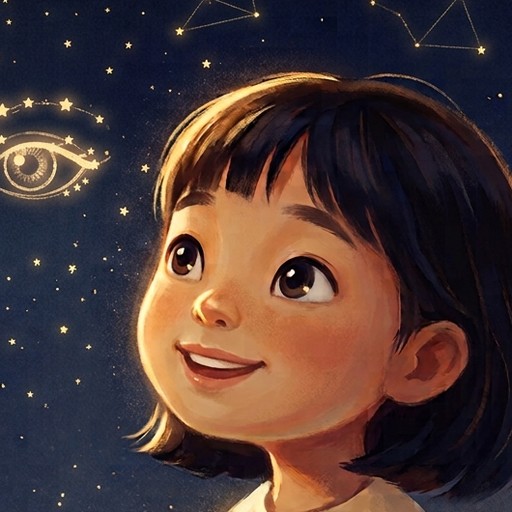
I want to tell you about a number.
Not just any number. A number that stole my sleep for years.
Thirty thousand.
But to get there I have to start much farther back. From a word, really. A Chinese word: fēi. It means "to fly." The character — 飛 — if you look closely, it looks like a bird spreading its wings.
My father gave me that name. The day I was born he was supposed to be at the hospital, in Beijing, beside my mother. Instead he arrived late. Insanely late. Not because of traffic, not because of an emergency. Because he had lost himself watching the birds in a park, and forgotten what time it was. What day it was. That he was about to become a father.
There. That was my father. A man who looked at the sky while the world waited for him. And when he finally arrived, he looked at me and said: we'll call her Fei-Fei. To fly.
He couldn't have known it, then. But he had just handed me the one instruction I would follow for the rest of my life.
I grew up in Chengdu, in China. A city of concentric streets, gray, orderly. My parents were strange, by the standards of that place. My mother came from a family tied to the wrong side of history — the Kuomintang, the losers. She had a ferocious intelligence and an outlaw's temperament. As a child she put book after book into my hands: Twain, London, Hemingway, Dickens. Translated into Chinese. She opened worlds for me.
And she taught me something that, back then, in that place, was almost an act of rebellion. She told me: Fei-Fei, you must not study for the teacher. Not for an ideology. Not for reputation. You must study for yourself.
One day — I was ten, eleven years old — the teacher sent all the girls out of the classroom. She kept only the boys. And she told them: you are biologically more intelligent than the girls. Soon they will become stupid, and you have no excuse to earn lower marks.
I cut my hair very short that day. I refused to wear skirts. And I decided I would do the most masculine things I could imagine: hypersonic planes, aerospace science, even UFOs.
I didn't know it yet, but I was already learning the lesson of my life: when someone tells you that a world is not for you — that is exactly the world you must conquer.
Then my father left. For America. Alone. It took him three years to bring us over. And in 1992, at fifteen, with my mother, I boarded a plane in Shanghai. She told me something, mid-flight, to lift my spirits: "Learning a new language is like opening a door onto a new world."
The America I found was not the one from the movies.
It was a one-bedroom apartment in Parsippany, New Jersey. My bed wedged into a narrow space between the kitchen and the table. Furniture salvaged from the sidewalks. My father repaired cameras, my mother worked as a cashier. I did my homework with two enormous dictionaries, one Chinese to English, one the other way around, and it took me hours to get through the simplest things.
My first job was in a dark Chinese restaurant, off the books. Two dollars an hour. Twelve hours a day. The neighborhood was dangerous at night, and they told me never to walk home alone.
And now I have to introduce you to someone.
I was good at math. Brilliant, in China. But in America something wasn't adding up. I took the first test of the year and got an eighty-nine point four. Eighty-nine point four. I was stunned — I had missed the written questions, the ones in words, because I still didn't understand English well. The teacher, a very tall, brusque man, dismissed me with a single sentence: "You know, there are a lot of bright kids in this class."
It wasn't exactly a welcome.
Then I started getting the calculations wrong. Not the words: the numbers. Errors with no logic, no sense, that I couldn't explain to myself. Until that teacher asked me for my calculator. He took it, pressed a key, and suddenly he burst out laughing — with joy, with surprise.
"A-ha! The tangent! Fei-Fei, it's the tangent key! Look." He set his calculator beside mine. Same number entered, two different results. "You've been working with a broken calculator! That must be a relief to find out, no? Hey… do you mind if I ask where this thing came from?"
"From a flea market," I murmured. Embarrassed.
"Oh," he said. And I understood it wasn't the answer he'd expected. "Well… we'll see about getting you one to borrow, okay?"
That teacher's name was Bob Sabella.
Bob was huge, bearded, gruff. The son of Italian immigrants who had mocked him for his love of books and science fiction. A man who had felt like an outcast even among his own brothers, and who had taken refuge inside his own mind because outside there was no room for him.
I began going to his office after school. At first only for math. But one day the conversation drifted elsewhere, and he asked me, almost offhand: "Do you know any other Western writers?"
"Yes, so many!" I said. "I love Mark… Twain. And Jack London. And Hemingway. And Dickens, and…"
He looked at me as if I'd said something impossible. "Wait, wait. You're telling me you've already read them all?"
"Not in English," I answered. "Chinese translations. My mother gave them to me, in China."
And he slumped back in his chair and started to laugh. Out of pure joy. It was the first moment — the very first — that an American looked at me and saw something more than an immigrant who spoke bad English. He saw a girl who had read Jules Verne, like him. One who could understand him.
From there, everything changed. I went to him every day. And I began to talk to him — before anyone else in America — about the money that wasn't there, the fights at home, the loneliness. He didn't look at my nationality, or my limping English. He saw a lonely girl trying to find her place. And, more importantly, he saw in me something I couldn't see myself.
One day he took me on a trip to Princeton. And there, in the middle of the campus, I froze in front of a bronze bust. I recognized that face. I read the inscription: Albert Einstein. Born in Ulm. And then, further down, the words that took my breath away: Nobel laureate, philosopher, educator, and immigrant.
Immigrant. Like me.
I stood there, stunned. The world around me had vanished. I applied to Princeton almost as a joke, a symbolic gesture — we couldn't afford it, it was absurd even to think about it. And instead the acceptance came. With a scholarship that covered nearly everything.
But it was in those very years that life set the hardest trial before us.
My mother's heart was failing. As a teenager she had had rheumatic fevers that ruined her heart valves, and now, as an adult, she was paying the price: a degenerative, chronic illness. The doctors had once even advised her against having children. Too dangerous. That child was me. I owe my existence to her rebellious spirit.
She needed an operation. And it cost an order of magnitude more than everything we had set aside in years of obsessive frugality. We were backed against the wall. Then chance — or luck — led us to a specialized center near Princeton, the Deborah Heart and Lung Center, which had programs for low-income families. I made the calls, in my usual role as translator between the receptionist and my parents. And I discovered, with my hands trembling, that they really could help us.
The operation went well. But then the doctor was clear: "Stress is the worst enemy of a heart like this. Does your mother work?" Yes, full-time. "That will have to change. Part-time, at most. And with extreme caution."
Two weeks later, my mother was back at work full-time. Because that was who she was. But we could no longer pretend. Something had to change for real.
At first we thought of a Chinese grocery store. It made sense: how many other immigrants drove for miles to find the ingredients of home? But then we stopped. A store like that lives on deliveries at dawn, when New Jersey winters are freezing. And the cold — the cold itself — was the main trigger of my mother's symptoms. That plan would have killed her. We threw it out.
And so we arrived at the dry cleaner.
We thought it over and it seemed perfect. It was a business you could open and close at human hours, indoors, sheltered from the weather: my mother would never catch cold again. It was essentially mechanical work — boilers, presses, conveyor belts — and finally my father's talent with machines would be good for something. And customer traffic rises on weekends: I could be there, helping, when I got home from school. Every box was ticked. Except one: none of us had the slightest experience.
It cost a hundred thousand dollars. We had barely twenty thousand. But in all those years we hadn't only put together money: we had put together a network. Friends, neighbors, other Chinese immigrants. We scraped together nearly eighty thousand dollars. We were still missing the last piece. And there we ran aground. The weeks went by, and the idea began to fade.
One weekend Bob offered to drive me home. I climbed into his old Subaru, and I knew right away something was up. He had that way of his, when something was too big to say: he circled it, turned it over, as if begging me to pull it out of him.
"Listen, I… um… the other night I talked with Jean. We discussed a few things, and… well, I didn't expect her to be so generous. She… you know she's really generous, in all this, and I…"
"Mr. Sabella, I don't understand what—"
"I'm trying to tell you that we're going to lend you the rest of the money you need to buy the dry cleaner!"
A high school teacher. On an ordinary salary. With children about to go to college. He lent tens of thousands of dollars to the family of one of his students. To immigrants he'd known only a few years. Just because he couldn't bear the thought of watching us go under.
Remember this loan. Because we'll come back to it. And it will break your heart the way it broke mine.
Before I left for Princeton, Bob asked me a question with a shyness I rarely saw in him. He wanted to know — if it wasn't a problem — whether I'd like to stay in touch with him and his family after graduation.
I couldn't help laughing. He hadn't realized he'd become my closest friend. Almost the only one. That the Sabellas were already my American family. The question wasn't whether I wanted to stay in touch. It was how I would survive in this country, without him.
And so, Princeton.
I studied physics. I loved Einstein, Feynman, Bohr. But the thing that truly changed me, there, was not the equations. It was two professors. Two ways of looking at the world that I have never forgotten.
The first was a geneticist, Eric Wieschaus. Someone who looked more like a carpenter than a scientist: loose plaid shirts, a thick mustache, unkempt hair, a soft voice. One autumn morning he came in and said: "I hate to do this, but I'm afraid class today will end half an hour early. Because… well, some of you may already know… This morning I got a phone call. Christiane Nüsslein-Volhard, Edward Lewis, and I… we won this year's Nobel Prize in Medicine."
The room exploded. And he, embarrassed, told us that it had all begun by cataloguing fruit flies — looking for the genes that caused defects — and that they had stumbled onto something enormous: the same genes, in human beings, responsible for disease. "Not exactly a smart career move," he said, laughing. "But what can I say? It's easy to be brave, when you're young."
And then there was him.
An astrophysicist, then unknown. He came in by train from New York once a week, where he directed the planetarium. And he had a ritual, before every lecture: he took off his jacket. Then his tie. Then his watch. He set his wallet on the desk. Sometimes he even took off his shoes. He wanted nothing left between himself and his obsession — the universe.
His name was Neil deGrasse Tyson.
The last lecture of his course I have never forgotten. He dimmed the lights. He projected a photograph — the famous one taken by the Hubble telescope, the ultra deep field: a tiny patch of black sky, dotted with little lights. And he spoke softly, in a voice that seemed to come from the far end of the cosmos.
"Everyone take a deep breath. Just… let this photo overwhelm you. Those tiny points of light are not stars. They're not even star systems. They are entire galaxies. Hundreds of thousands of them. It's a scale our small brains can't even process. But thanks to instruments like Hubble, our species can see them. For the first time."
And then he said the thing I have carried with me ever since, every single day:
"Be curious. Be brave. Always be willing to ask impossible questions. Because the answers can be wonderful."
Remember this image. The dark, the little dots, the galaxies that become visible only because someone built the right instrument to look. We'll come back to it. At the end of everything.
Because at Princeton I understood something. It wasn't physics itself that called to me. It was the courage of physics. That audacity to ask the world the most impossible questions — just as Tyson said. And the most impossible question of all, for me, was not how the universe works. It was: how does the mind work. How does a kilogram and a half of matter, sealed in the dark of the skull, generate love, fear, music, mathematics — generate us.
I wasn't the first to ask it, that question. And here I have to pause, because I want to tell you about the giants on whose shoulders I was climbing without yet knowing it.
There was Alan Turing, who in 1950 had dared to ask: can we build a machine that thinks? And he had suggested something revolutionary — instead of programming an adult mind, why not build one that learns, like a child?
There were the men at Dartmouth, in 1956, who gave that thing a name: artificial intelligence. John McCarthy, Marvin Minsky, Claude Shannon. They thought they'd solve it in one summer. It's taken us more than half a century, and we're not finished.
There was Frank Rosenblatt, a psychologist, who in 1958 built a neuron out of metal and called it a "perceptron" — a machine that learned to see shapes. And then there was Minsky again, who a few years later wrote a book so severe about that perceptron that it buried the whole idea for more than ten years.
There were two neuroscientists, Hubel and Wiesel, who opened up a cat's brain and discovered that we don't see all at once: we see in layers. First the edges, the lines, the shadows. Then, layer after layer, the faces, the objects, the world. They won a Nobel for it.
And there was one man, above all. Geoffrey Hinton. Who in the 1980s, with Rumelhart, found the way to make neural networks truly learn — a technique called backpropagation. And who then, when everyone said neural networks were a dead end, that they were dead — refused to let them go. He kept believing in them when believing meant becoming an outcast among his colleagues. His student, Yann LeCun, taught a neural network to read handwritten postal codes, at Bell Labs, in the very years my family was arriving in America.
Each of these names deserves its own tale. Each had their own dry cleaner, their own winter, their own Bob Sabella. Our lives weave together like the threads of a net. And today I'm telling you mine — but I'm also introducing you to my family. The family of those who lit this thing.
But before Caltech, life tested me. It was 1999, I was graduating from Princeton, and half of Wall Street wanted me. Goldman Sachs, Merrill Lynch — they offered me dizzying salaries, the erasure of all our debts, the end of work at the dry cleaner, financial security for my ever-sicker mother. In exchange I had to give up one thing only: science.
I thought about it for days. Then, one afternoon, I talked it over with my mother at the dry cleaner. She was at the sewing machine, pins clenched between her lips. I laid it all out for her: the money, the health, the exhaustion that would end. She paused for a moment.
And she reminded me of what she used to tell me as a child: that I must not study for others, but for myself. If my heart was in science, she said, that was the only place I could be. I turned it all down. I went back to pressing the clothes, and I applied for the doctorate.
It was at Caltech, during my PhD, that I found my thread.
I had two wonderful mentors. Pietro Perona — Italian charm, boundless curiosity, a Mondrian poster on the wall. And Christof Koch, a neuroscientist, with limitless imagination. They taught me to join two worlds: the mind and the machine.
The problem was this. We wanted to teach computers to see. To look at a photo and say: this is a cat, this is an airplane, this is a cup. For a human brain it's trivial. A three-year-old does it. For a machine, back then, it was almost impossible.
We built cleverer and cleverer algorithms. And they all failed the same way. They worked in tests and collapsed in the real world. They memorized the examples, but they couldn't generalize. They couldn't handle surprise. And surprise is everything, in the real world.
I was convinced I was getting something wrong in the algorithm. I made it smarter, more elegant, more complicated. And it was never enough.
Until I met that number. Thirty thousand.
A psychologist, Irving Biederman, had estimated how many categories of objects a human being can distinguish. How many different "things" we're able to recognize. Not a thousand. Not five thousand.
Thirty thousand.
And there I understood that I had been looking at the problem from the wrong side the whole time. It wasn't the algorithm that was the problem. It was the food. We don't learn to see because our brain is well programmed. We learn to see because, from the day we open our eyes, we are flooded with millions and millions of images. Experience. Data.
A child doesn't see one airplane and know what it is. It sees thousands of them. And then, in the end, it recognizes them all.
And what if — I asked myself — we built the same thing for machines? What if we gathered a dataset that contained everything? Every single thing a human being can see and name?
There was already a map of all the words in the world. It was called WordNet, created by a psychologist, George Miller — a hundred and forty thousand words linked by meaning. I wanted the same thing, but made of images.
I called it ImageNet.
And that was when the world, politely, told me I was crazy.
"What's the use of a dataset with tens of thousands of categories? Models struggle to recognize one or two!"
"Do you have any idea how long it will take to train it? Years!"
"Who's going to label millions of images? Who?"
"Fei-Fei, it makes no sense. I'm sorry."
The rejection was almost unanimous. And the worst part is that they weren't entirely wrong. I felt lonelier than I ever had. I needed an army, and I couldn't find a single soldier.
I found one. Kai Li. The only other Chinese immigrant in Princeton's computer science department — where in the meantime I had become a professor. He couldn't work on it himself, but he understood exponential thinking better than anyone. He donated workstations to me. And he gave me the most precious thing of all: a student.
His name was Jia Deng.
We began. We hired students at ten dollars an hour to download and label images. Jia timed the pace, did the math. He looked at me and said: at this speed, ImageNet will be complete in… nineteen years.
Nineteen years. We automated everything we could. Google banned us for running too many searches. We found tricks, shortcuts. We redid the math. From nineteen years we came down to… eighteen.
Then Jia said a word that changed everything. Crowdsourcing. Amazon had just launched a platform — Mechanical Turk — where people all over the world could do small tasks. Our team went from three students to dozens. Then hundreds. Then thousands of people, in a hundred and sixty-seven countries.
And the time collapsed. Eighteen years. Then fifteen. Then ten. Then five. Then two. Then less than one.
In 2009 ImageNet was complete. Fifteen million images. Twenty-two thousand categories. Labeled by hand by nearly fifty thousand people around the world. Every single image, looked at by a human eye, three times.
And among those thousands of hands labeling the entire world, there was a pair I knew well. My mother's. Ill, by then living with me. She found a way to help too.
And then nothing happened.
We presented ImageNet to the world, and the world shrugged. The critics were dismissive. No one used it. I toured the universities like a door-to-door saleswoman, begging someone to try my data. We turned ImageNet into an annual competition, a challenge open to everyone. In 2010 an old algorithm won, with a mediocre result. In 2011, worse still. Participation was collapsing.
I began to think I had devoted years of my life to a failure.
And here I have to come back to Bob.
It was 2012. I was pregnant, seven months along, confined to bed by the doctors. And one night, late, the phone buzzed. On the screen a name I didn't expect at that hour: Jean. Bob's wife.
"Fei-Fei… Bob has fallen."
"What? Is he hurt?"
"No, no. Something's wrong. He can't keep his balance. He… he doesn't seem like himself."
I asked to speak to him. I heard Jean hand him the phone, whisper "it's Fei-Fei." And then his voice — distant, labored, one I didn't recognize. "Bob, Jean says you fell. How are you feeling? Do you want me to come? I can leave right away."
And on the other end I heard something I had never heard in my life.
Bob. Crying.
Twenty-four hours later the diagnosis came. Glioblastoma. Terminal. Inoperable.
The man who had saved our lives — who had lent his savings to a family of strangers, who had taught me to call him "Bob" instead of Dr. Sabella, who not long before, at his retirement party, had stood up and spoken with pride about his "two sons… and his daughter" — that man was gone in three weeks. He lost consciousness a few days after the diagnosis, and never woke again.
I couldn't even go to the funeral, because of the pregnancy. My husband went in my place, across the country.
My father broke down and wept the moment he heard. They called him, in Chinese, "the big bearded math professor." He had been, for all of us, a third parent. And the only thing I had left of him, afterward, were the pages of his diary: he had taken up the habit of emailing them to me at the end of each month. We had become digital pen pals. Pages and pages of his thoughts. I still reread them.
And it was in that same 2012 — in the very weeks I was losing Bob — that the phone rang again. It was Jia. But this time the voice wasn't anguished. It was… electric.
"Fei-Fei, we've looked at this year's challenge results. One of them is… you won't believe it. It uses an ancient algorithm. It's a neural network. And you have no idea how well it works."
A neural network. Those things everyone had declared dead thirty years earlier.
It had won by a leap of ten percentage points. The world record. The machine, now, saw almost like a human being.
Its name was AlexNet. After the one who built it: Alex Krizhevsky. With him, a brilliant young researcher — Ilya Sutskever. And a third name, at the bottom of the list, that made my breath catch.
Geoffrey Hinton.
The same Hinton. The one from backpropagation, in the 1980s. The one who had refused to abandon neural networks when it made him look like a madman, a pariah. He had waited twenty-five years. And now, his student, on my images, with two videogame graphics cards bought at the store, had built the longest comeback in the history of science.
Do you understand what had happened? Hinton's ideas had finally found ImageNet's data. One man's dream had met one woman's mad labor. And in between, chance: the graphics cards born to blow up zombies in videogames had turned out to be perfect for making machines think.
None of us, alone, could have done it. Hinton without the data, nothing. Me without his networks, nothing. All of it without those graphics cards, without the thousands of people who had labeled the world — nothing.
Science is not the lone genius. It's a constellation. It's many distant lights that, seen from far enough away, finally form a figure.
That was the moment the artificial intelligence you know today was born. In one room, with very few people who knew they had just made history.
But I had just buried Bob. And soon after, in a hospital bed, there was my mother again.
And it was she who asked me the most important question of my life. She looked at me — after all those years in which I had treated her only as a patient, keeping my work to myself — and she asked: "Fei-Fei, but what exactly do you do?"
I tried to explain to her. ImageNet, the networks, the graphics cards, the world that was changing. She listened. Then she said: "I don't know. It sounds like science fiction to me."
My mother never thought in equations. She always thought in stories. In people. And so she asked me the question that changed the second half of my career. Not "how powerful is your machine." But:
"Fei-Fei — what else can artificial intelligence do to help people?"
From then on I stopped asking only how much machines can see. I began to ask for whom. I brought these technologies into hospitals, where every year a hundred thousand people die from avoidable errors — a patient left alone a minute too long, a hand not washed. I built silent eyes that keep watch in the dark corner, where no doctor can always be.
And those same artificial eyes — the sight I had wrenched from the dark — would one day even learn to drive cars on their own. But that's another tale: the last of this constellation, that of a man who as a child played at saving the Earth and who, on the sight born from my images, built his machines. You'll hear about him too. His name is Elon Musk.
And here, now, I want you to come back with me to that dark lecture hall at Princeton.
The Hubble photo. The dots in the black. The galaxies that become visible only because someone built the right instrument to look where the eye, alone, cannot reach.
I have understood, after all these years, that this is exactly what I've spent my life doing. Not building a telescope for the sky. But a lens to look at us. Computer vision has let us see things that had always been there, right in front of us, invisible: the patterns of an entire city, the dark corner of a hospital, the exact moment a patient needs help and no one notices.
Tyson said that thanks to Hubble our species can see the galaxies for the first time. There. I wanted to build an instrument like that — but pointed not toward the infinitely far. Toward the infinitely near. Toward the person in the next bed.
And so I think back to that bronze bust. Beside the word "genius," on Einstein, it also said: humanist. Immigrant. Educator. For years I thought the first word was what mattered. Now I know it's the others.
Because I am the daughter of a man who watched birds and a woman with a broken heart and a head full of books. I grew up pressing clothes in a dry cleaner bought with the savings of a small-town teacher. I learned English with two dictionaries and a broken calculator.
The technology you are watching being born in these years — artificial intelligence — will change everything. But it wasn't born from algorithms. It was born from people. From stubborn immigrants, from gentle teachers, from rebellious mothers, from giants who waited twenty-five years in the dark. It was born from love, however strange that may sound.
And so the question was never how much we can make machines see.
The question is Tyson's. And my mother's. They are the same question.
What are we finally willing to look at — in ourselves?
Be curious. Be brave. Ask impossible questions.
My name is Fei-Fei Li. My name means "to fly."
And all my life I have only tried to teach something — someone — to open their eyes. And not to be afraid of all those galaxies.
Source: Fei-Fei Li, «The Worlds I See».